
8.6 Blackout: Caliber of the Month
The 8.6 Blackout is redefining suppressed shooting with heavier subsonic bullets, short-barrel efficiency, and hard-hitting performance. Here’s why it’s one of the most talked-about cartridges right now.

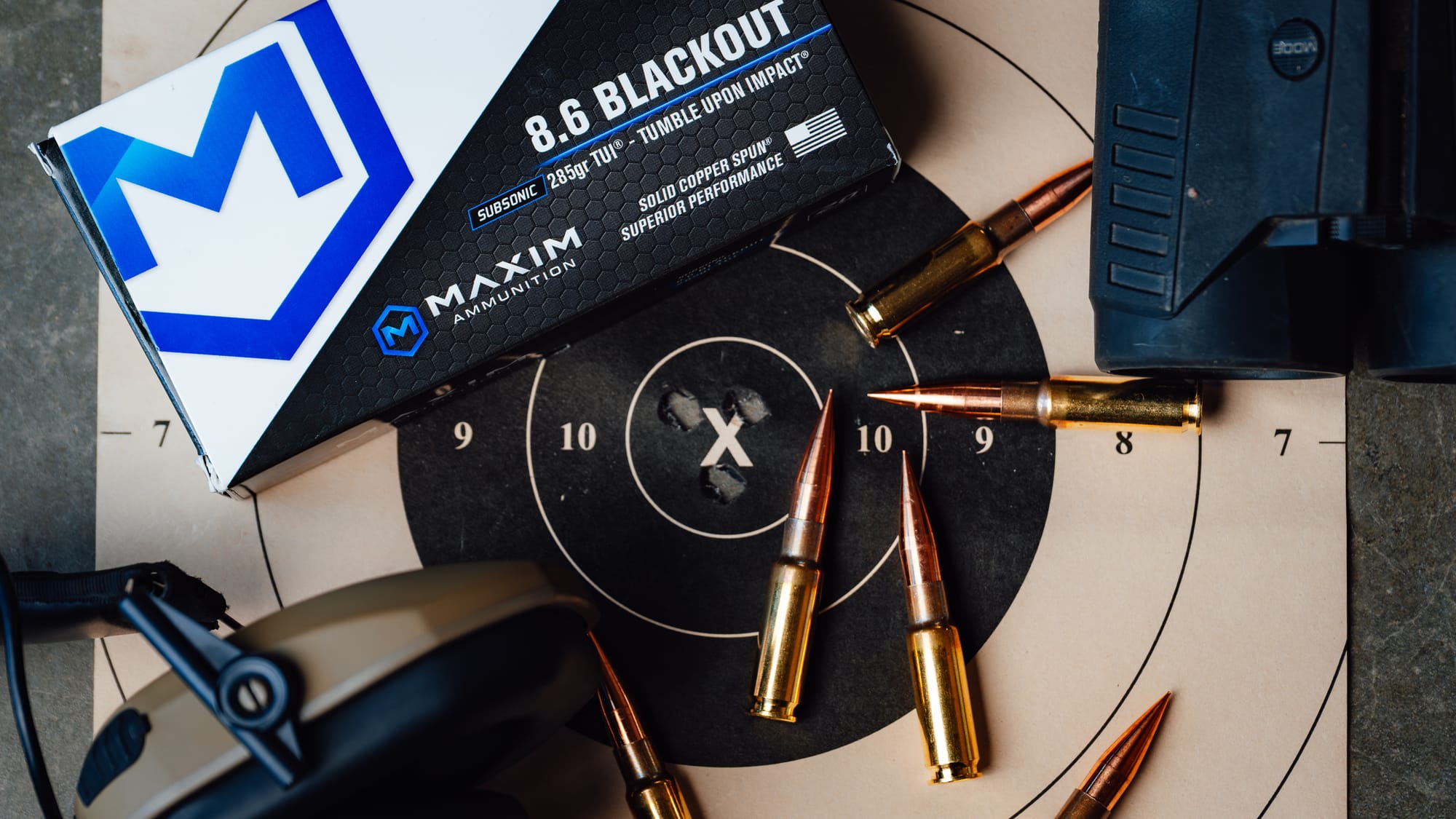
Adding a new cartridge to your lineup usually means making some trade-offs. More power means more recoil. Shorter barrels usually mean giving up velocity. But every now and then, something shows up that doesn’t really feel like a compromise at all.
Enter the 8.6 Blackout.
If you've messed around at all with .300 Blackout, you already get the draw: it's compact, efficient, and runs great suppressed. Still, there's always that itch to go bigger. The 8.6 Blackout basically asks, what if .300 Blackout hit the gym, bulked up, and didn't get any louder?
A question no one ever really asked out loud, but a lot of people were ready for anyway.
Let's take a look at why this cartridge is quickly becoming a standout for quiet, hard-hitting performance.
The Origin Story: Not Just a Bigger .300 BLK
To understand what 8.6 Blackout is all about, it helps to look at what it isn't.
This isn't just a stretched or necked-up .300 BLK. It was developed by Q in the early 2020s with the very specific goal of getting maximum performance from short barrels and suppressors using heavy, subsonic bullets.
Instead of working within AR-15 constraints, 8.6 BLK is built around a .308-sized case that's been shortened and necked up to accept .338-caliber projectiles. That means more case capacity, more bullet weight, and a lot more authority on target.
The tradeoff is platform size. This is an AR-10 or bolt gun cartridge, not something that drops into a standard AR-15. But in return, you're throwing projectiles that make 220-grain .300 BLK loads look pretty modest.
Why It Dominates the Suppressor Game
If you're here, you already know running suppressed doesn't equate to Hollywood-silent performance. You've still got action noise, and if you're running supersonic ammo, that sonic crack is always there.
If you want things truly quiet, you have to stay subsonic.
But that creates a problem.
Energy = ½ mass × velocity².
Yeah, I suck at match, too, but the takeaway is the same.
If velocity is capped at around 1,050 fps, the only real way to gain energy is to increase mass. That's exactly where 8.6 Blackout shines.
1. The "Thump" Factor
While .300 Blackout typically tops out around 220 grains for subsonic loads, 8.6 Blackout commonly runs 285- to 350-grain projectiles.
At similar subsonic speeds, that added mass translates into significantly more momentum and energy retention. It's the difference between getting hit with something light and fast versus something heavy and deliberate.
You feel it on steel, too. The impact has a deeper, more authoritative tone; less "ping," more "thud."
2. Designed for Suppression From the Start
8.6 Blackout was built around short barrels (often 8–12 inches) and fast-burning powders that fully combust before the bullet ever leaves the muzzle. That means lower muzzle pressure and less unburnt powder hitting your suppressor.
Pair that with a larger bore diameter (.338 vs .308), and you get more efficient gas expansion as everything moves through the can.
The result isn't just "quieter." It's a fundamentally different sound signature altogether. Deeper, lower-pitched, and less sharp than smaller calibers. It tends to blend into ambient noise more easily rather than cutting through it.
3. The 1:3 Twist Magic
One of the more distinctive aspects of 8.6 Blackout is its extremely fast twist rate, typically around 1:3.
That's not a typo.
Heavy .338 projectiles moving at subsonic speeds need that spin to stay stable, especially out of such short barrels. But it also does more than just stabilize the bullet. It increases rotational energy, which can influence how the projectile behaves on impact.
The end result is a round that performs more aggressively than its velocity numbers might suggest, especially at intermediate distances where it's meant to be used.
Where it really stakes its claim is in short, suppressed setups. Think compact AR-10 builds or bolt guns with a can. It's a friggin' dream, man.
As for use cases, it fills a very specific role: You're getting a quiet, controllable platform with subsonic performance that hits harder than most people expect. It's not about stretching distance as much as it's about doing work efficiently inside realistic ranges.
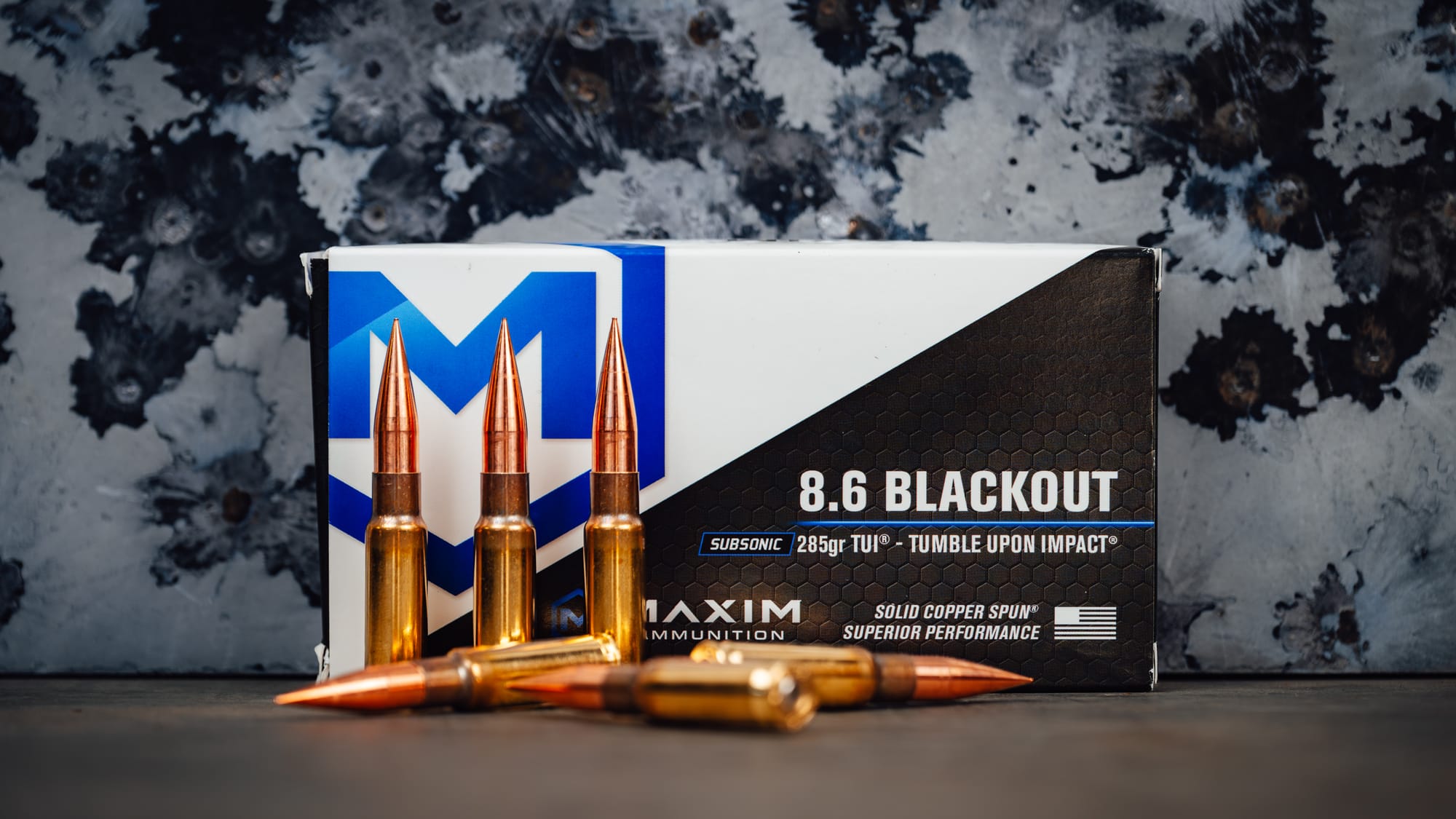
Why AmmoSquared Makes Sense for 8.6 BLK
Let's be honest: you're not finding 8.6 Blackout stacked deep at big-box stores.
It's a specialty cartridge, and availability can be hit-or-miss. Prices move around, and when it shows up on store shelves, it doesn't always stick around long.
This is where AmmoSquared's stockpile platform really comes in handy.
Instead of trying to time the market or drop a big chunk of cash all at once, you can build up a supply over time. It takes some of the pressure off when shooting a boutique caliber, especially one that's this purpose-built.
Because the reality is, once you start running a suppressed 8.6 setup, you're probably not going to want to leave it in the safe.
The Verdict
The 8.6 Blackout isn't a do-all cartridge, and that's exactly why it works.
It's not built for speed or distance, or to replace the more common top sellers like 5.56. It's built for suppressed hunting and tactical ops at intermediate ranges, delivering heavy, controlled performance with exceptional energy retention.
And it does that exceptionally well.
If you're already into suppressed shooting and want something that pushes past what .300 Blackout can offer, 8.6 BLK is worth adding to your AmmoSquared account and beefing up your suppressor-ready stockpile before the next shortage or price spike. Just sayin'.