
Caliber of the Month: .35 Remington
Discover why the .35 Remington remains a trusted deer hunting cartridge more than a century after its introduction. Explore its history, ballistics, effective range, and advantages for whitetail hunters, plus tips for staying prepared for hunting season.

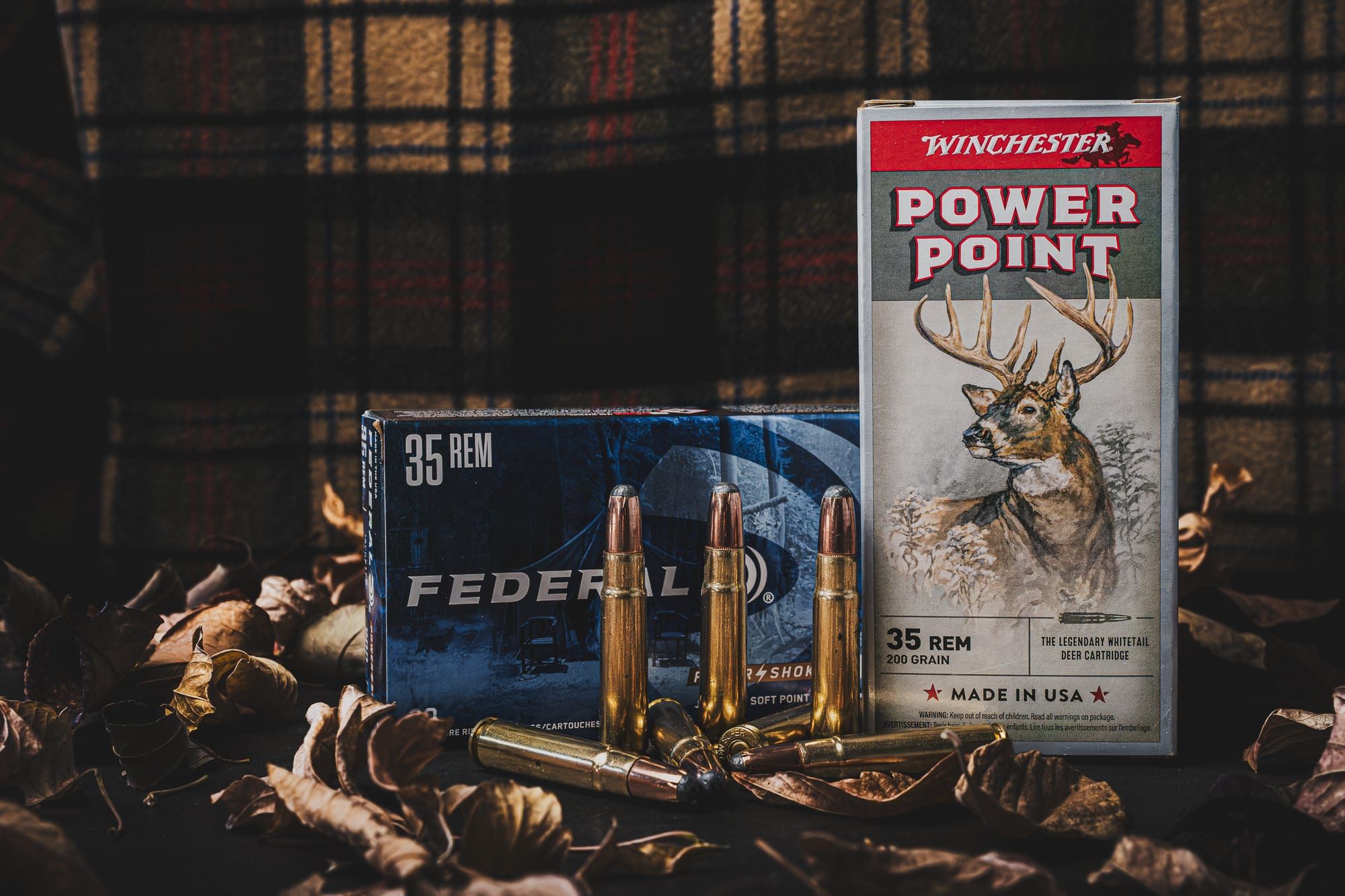
Introduced in 1906, the .35 Remington is an early smokeless-powder hunting cartridge. It found its stride in rifles such as the Remington Model 8 semiautomatic and later the Model 81.
Eventually, it became particularly well known in lever-action rifles, especially the Marlin 336.
The cartridge was developed when hunting rifles were generally fairly simple and basic. You didn't need a precision chassis and all the bells and whistles to take your target. You needed a reliable rifle, decent ammunition, and enough oomph to put the bullet where it belonged for a quick, clean kill.
Funny how some things haven't changed.
And that's really the appeal of the .35 Remington. It isn't the latest and greatest, and nobody will mistake it for a long-range wonder cartridge. It was built for practical hunting, especially in the woods, where shots usually occur at relatively modest distances.
More than a century later, it still holds its place in a crowded ammo market. Let's take a look at why.
So, What Exactly Is a .35 Remington?
At its core, the .35 Remington is a rimless rifle cartridge that traditionally throws a 200-grain bullet at roughly 2,000 feet per second, give or take a few, depending on the load and rifle. Its bullets measure approximately .358 inches in diameter, giving it a fairly substantial projectile by traditional deer-rifle standards.
Those numbers might not blow your hair back, but that's not really the point.
The .35 Remington relies on a relatively heavy bullet moving at moderate velocities. With the right bullet, that combination can deliver excellent penetration and reliable terminal performance on whitetail deer at sensible hunting distances.
And there's something to be said for that kind of practicality.
You don't need to push a bullet at 3,000 feet per second to kill a deer. Shoot, that might even be overkill.
You need a bullet that performs as intended and delivers enough penetration and damage to do the job humanely. Velocity is one part of that equation, not the whole dang thing.
The .35 Remington has more than enough capability for its intended role without requiring magnum cartridge performance or the additional recoil and expense that can come with it. Its moderate velocity also makes it a natural fit for traditional hunting rifles designed around close-to-moderate-range use.
Of course, not every .35 Remington load performs identically. Bullet design matters, especially when it comes to expansion and penetration.
The short version? The .35 Remington is a straightforward, practical cartridge that doesn't need to compete with modern magnums in order to be effective.
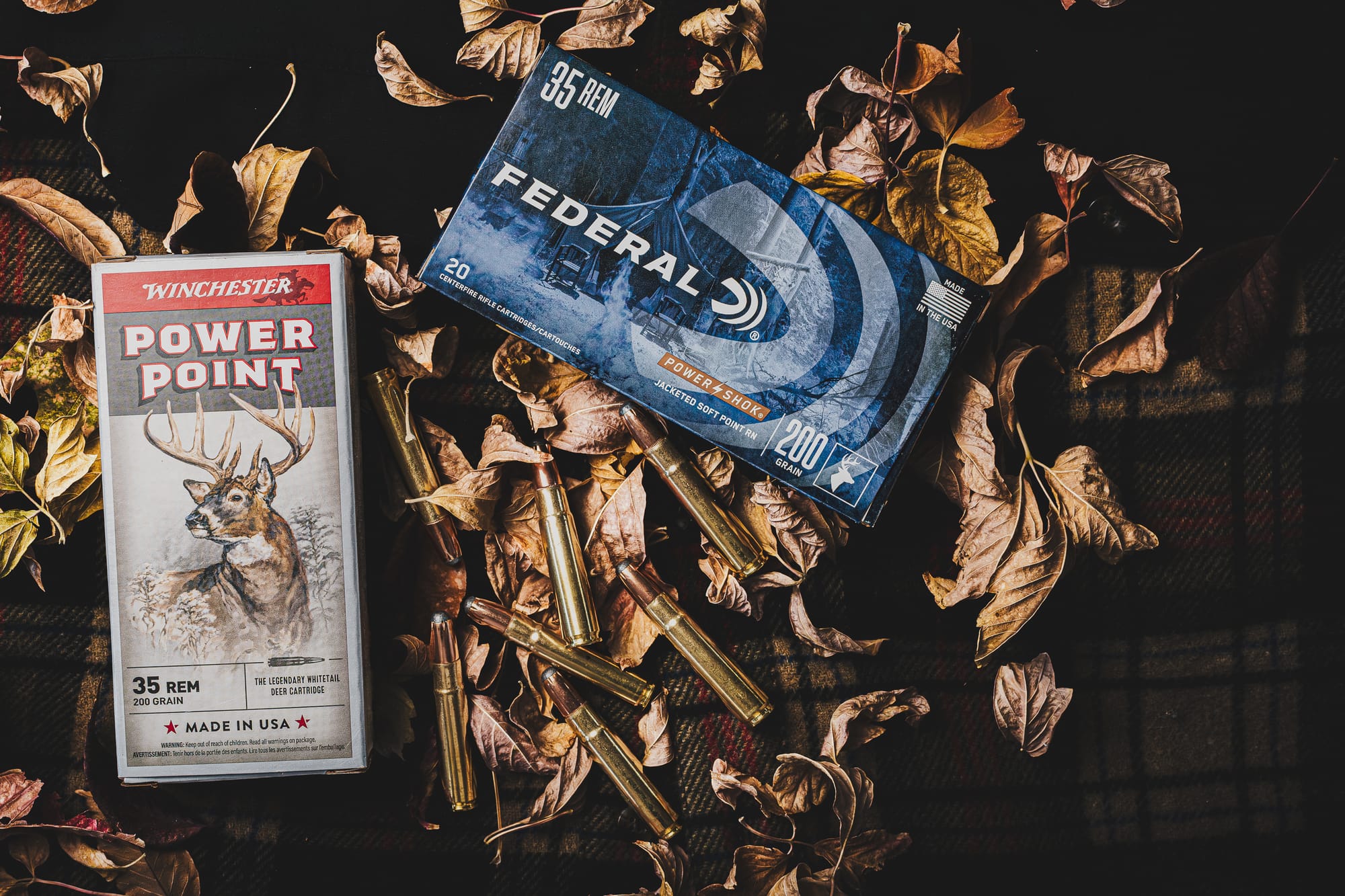
The .35 Remington as a Hunting Cartridge
Now that we've covered the history and basics of the cartridge, let's get to the part you really came here for.
The .35 Remington is a capable whitetail cartridge, especially for hunters working in timber, brush, creek bottoms, and other places where shots often occur within 150 yards.
Its traditional 200-grain projectile brings plenty of mass to the table for most mid-size North American game. Pair it with suitable bullet construction and reasonable impact velocities, and you've got a cartridge with a long-established reputation for putting meat in the freezer.
Obviously, that doesn't mean you can simply "spray and pray" and hope for the best. No cartridge gets that luxury. Shot placement, bullet construction, and terminal performance still matter. And just because a cartridge has a reputation for hitting hard doesn't mean every bullet loaded into it will perform the same way.
A suitable hunting bullet needs to expand properly while retaining enough integrity to penetrate vital tissue. Choose ammunition intended for the game you're hunting, learn how it performs in your rifle, and keep your shots within the distances where you can place that bullet accurately and confidently.
Do those things, and the .35 Remington has more than enough capability to drop that trophy buck that's been teasing your target camera all summer.
How Far Can You Shoot a .35 Remington?
Let's be realistic.
The .35 Remington isn't a particularly flat-shooting cartridge. Its relatively heavy bullets leave the muzzle at much slower velocities than many more modern hunting rounds, so bullet drop becomes a bigger consideration as distance increases.
The cartridge is well suited to the sort of close-to-moderate-range hunting most people associate with wooded terrain and traditional deer hunting. Inside 150 yards, it's incredibly capable. Beyond 150 yards, well, there are more limitations.
At longer ranges, bullet drop becomes more pronounced, and wind, range estimation, and remaining impact velocity become increasingly important. The .35 Remington can certainly put a bullet downrange, but that doesn't automatically make it the best tool for stretching shots across an open field.
That doesn't mean 150 yards is a hard cutoff. Actual performance depends on the load, rifle, sight setup, conditions, and your skill and ability as the shooter. Some hunters will be comfortable shooting farther, while others are better off well inside that 150-yard range.
As with any cartridge, the most important thing is to know where your bullet will land and how well it will perform at the distance you're considering. The .35 Remington is hardly an exception.
The Downsides
The .35 Remington isn't perfect. Far from it, it has a few unique drawbacks. Nay, considerations.
First, ammunition availability can be a bit of a nuisance. The cartridge is still supported, but it isn't as commonly stocked as popular choices like .308 Winchester or .30-06 Springfield. Depending on where you shop and when you look, you might find a few boxes sitting on the shelf, or discover that your local store hasn't had any in weeks.
Neither is a particularly good surprise the week before deer season. But that's why we're here, right?
Shameless plug.
Second, your rifle options are more limited. The .35 Remington is primarily associated with traditional hunting rifles, particularly older turn-of-the-century models. Finding a specific rifle in good condition can take patience, and anyone hoping to choose from a wide selection of brand-new rifles may be disappointed.
For collectors and hunters who value traditional firearms, though, that can be part of the charm. So, it really depends on the shooter. But the supply question still stands.
The Bottom Line
The .35 Remington is an old-school hunting cartridge that still makes a lot of sense for the right hunter.
It launches a heavy, purpose-built bullet at moderate velocity, offers dependable performance on whitetail deer and other mid-size game, and pairs particularly well with traditional lever-action, pump-action, and semiautomatic hunting rifles. Its recoil is generally manageable, though the rifle's weight and an individual shooter's tolerance make a difference.
If your hunting revolves around whitetail deer in the woods, the .35 Remington is a perfectly sensible choice. It has a long track record, a practical design, and no need to pretend it's something more modern or complicated than it is.
And if you've got one in the safe, take care of it, practice with it, and keep ammunition on hand. A good hunting rifle doesn't become less useful simply because the industry has moved on to the next big thing.
The .35 Remington has been around since 1906. It has outlasted plenty of cartridges that arrived with a lot more fanfare, and it can still put meat in the freezer today.
If it's the right cartridge for your next deer season, make sure you've got the ammunition to go with it. Add some to your AmmoSquared account today, and you'll be a little better prepared when hunting season rolls around.
Be sure to sign in to your AmmoSquared account today, as it will only be available for the month of November.